
How Much Protein Do You Need While Losing Weight?
The official minimum is 0.8 grams of protein per kilogram of body weight a day, but the current Dietary Guidelines aim higher. Here is what the numbers mean and who should ask a clinician first.
By Search & Report Editorial Team · Updated November 21, 2026 · 6 min read
Key takeaways
- The Recommended Dietary Allowance for adults is 0.8 grams of protein per kilogram of body weight a day. It is a minimum, not a weight-loss target.
- The 2025-2030 Dietary Guidelines for Americans set a higher goal of 1.2 to 1.6 grams per kilogram a day.
- In pooled trials, higher-protein diets helped people keep a little more lean mass while losing weight. The benefit was modest.
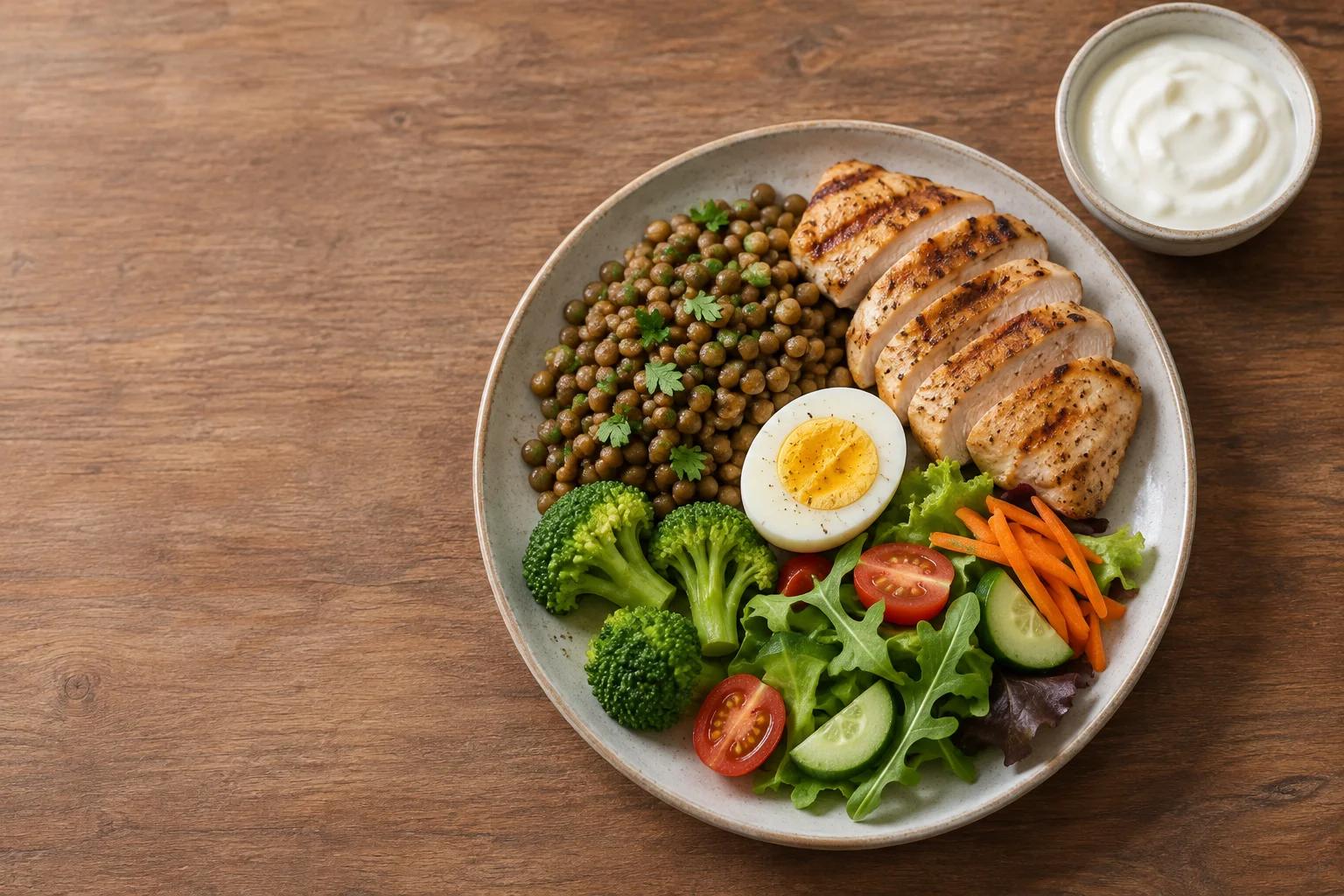
- Protein can come from meat, poultry, seafood, eggs, dairy, beans, lentils, nuts, seeds and soy.
- People with kidney disease or another chronic condition have reason to ask a clinician before eating more protein.
When people eat fewer calories to lose weight, the weight that comes off is not all fat. Some of it is lean tissue, which includes muscle.1 Eating enough protein can help limit that loss.1 The hard part is knowing how much is enough, because official sources give more than one number.
This article explains where those numbers come from, what weight-loss studies have found, and how to estimate a range to discuss with a clinician or registered dietitian.
What the Recommended Dietary Allowance means
The Recommended Dietary Allowance, or RDA, for protein is 0.8 grams per kilogram of body weight a day for adults. The National Academies reaffirmed that figure in a 2002 report. The same report set a wider range of 10% to 35% of daily calories from protein.2
An RDA is the daily amount that meets the needs of nearly all healthy people. The protein RDA was built to estimate the smallest amount a person must eat to avoid losing body nitrogen, a marker of body protein.3
So the RDA is best read as a minimum.3 It was not designed as a target for weight loss.
A higher goal in the current Dietary Guidelines
The Dietary Guidelines for Americans, 2025-2030, came out in January 2026. They set a protein goal of 1.2 to 1.6 grams per kilogram of body weight a day, adjusted as needed for a person's calorie needs.4 That is one and a half to two times the RDA.
The National Academies did not set an upper limit for protein. It said the data on high-protein diets were too conflicting or incomplete to choose one, and it urged caution about amounts well above what foods normally supply.2
What research says about protein during weight loss
Several reviews have pooled weight-loss trials that compared diets with more and less protein.
- A 2012 analysis of 24 trials covered 1,063 people on reduced-calorie diets with matched calories. The diets lasted about 12 weeks on average. People on the higher-protein diets lost 0.79 kilograms (about 1.7 pounds) more weight and 0.87 kilograms (about 1.9 pounds) more fat. They also kept 0.43 kilograms (about 1 pound) more lean mass. The authors called the benefits modest.5
- A 2016 review of 20 trials looked at adults over 50. Those who ate more protein kept more lean mass and lost more fat during weight loss. Higher protein meant at least 25% of calories, or at least 1.0 gram per kilogram a day.6
- A 2015 review concluded that diets with 1.2 to 1.6 grams per kilogram a day may help with appetite and weight management. It also found that longer studies gave mixed results, largely because many people did not stick to the diets.7
What protein cannot do
More protein is not always better. A 2017 review found that a high protein intake helps preserve muscle during weight loss but does not make muscles stronger. It also raised the possibility of unwanted effects on metabolism. The authors favored adequate, but not excessive, protein together with more physical activity, especially resistance exercise.1
Our article on strength training during weight loss covers that side of the research.
How to estimate a range for yourself
Both official figures use body weight in kilograms. To convert, multiply your weight in pounds by 0.45.8 Then multiply by 0.8 for the RDA,2 or by 1.2 and 1.6 for the Dietary Guidelines goal.4
| Body weight | RDA minimum (0.8 g per kg) | Dietary Guidelines goal (1.2 to 1.6 g per kg) |
|---|---|---|
| 70 kg (about 154 lb) | 56 g a day | 84 to 112 g a day |
| 90 kg (about 198 lb) | 72 g a day | 108 to 144 g a day |
| 110 kg (about 243 lb) | 88 g a day | 132 to 176 g a day |
These are worked examples of the published figures, not personal targets.24 Two points put them in context:
- The numbers rise with body weight. The Dietary Guidelines say to adjust the goal to your calorie needs.4 A clinician or registered dietitian can help choose a figure that fits your health and your eating plan.
- Protein has calories too. Each gram supplies 4 calories, so 100 grams is 20% of a 2,000-calorie diet. That sits inside the 10% to 35% range.9
Where the protein can come from
The Dietary Guidelines recommend a variety of protein foods. From animals, they list eggs, poultry, seafood and red meat. From plants, they list beans, peas, lentils and other legumes, nuts, seeds and soy. They also describe dairy as a source of protein. For cooking, they suggest baking, broiling, roasting, stir-frying or grilling in place of deep-frying.4
MedlinePlus, a service of the National Library of Medicine, offers a rough guide. Each of these has about 7 grams of protein:9
- 1 ounce of meat, fish or poultry
- 1 large egg
- A quarter cup of tofu
- Half a cup of cooked beans or lentils
MedlinePlus adds that animal products are not required to meet protein needs, and that nuts are high in fat, so portion size matters.9
Does it matter when you eat it?
The Dietary Guidelines advise making protein foods a priority at every meal.4 The research on timing is thinner than the research on daily totals.10
In one small study, 8 healthy adults ate about 90 grams of protein a day in two patterns, for 7 days each. Eating roughly 30 grams at each of three meals led to 25% more muscle protein building over 24 hours than eating most of the protein at dinner.11 The study was short, and it measured muscle protein building, not muscle size or strength.
A 2020 review judged the evidence for an ideal pattern to be limited and inconsistent, and hard to separate from the effect of total daily protein.10
Including a protein food at each meal can make a daily total easier to reach. Whether the pattern adds a benefit of its own is not settled.10
Who should talk to a clinician first
For adults with healthy kidneys, the findings are more reassuring. A 2018 analysis pooled 28 trials with 1,358 adults who did not have kidney disease. The change in kidney filtration rate, a measure of how well the kidneys clean the blood, was no different on higher-protein diets than on diets with less protein. The diets lasted 4 days to 2 years, and the authors rated the quality of the evidence as low to very low.13 That result does not apply to people whose kidneys are already damaged.
Others have reason to ask before changing how much protein they eat:
- People with a chronic disease. The Dietary Guidelines tell them to ask a health care professional whether the guidelines need to be adapted for them.4
- Adults over 65. A 2013 position paper recommends at least 1.0 to 1.2 grams per kilogram a day for healthy older people. It adds that those with severe kidney disease who are not on dialysis may need to limit protein.14
- People who are pregnant. The National Academies set a higher protein allowance for pregnancy.2
The bottom line
The RDA of 0.8 grams per kilogram a day is a minimum for healthy adults.23 The current Dietary Guidelines set a higher goal of 1.2 to 1.6 grams per kilogram a day.4 In weight-loss trials, eating more protein helped people keep a little more lean mass, and the benefit was modest.5 Protein works alongside physical activity, not in place of it.1 Anyone with kidney disease or another chronic condition, and anyone who is pregnant or over 65, has good reason to talk with a clinician or registered dietitian before eating more protein.41214
Footnotes
-
Cava E, Yeat NC, Mittendorfer B. Preserving Healthy Muscle during Weight Loss. Advances in Nutrition 2017;8:511-519. PubMed ↩ ↩2 ↩3 ↩4
-
National Academies, Institute of Medicine, Report Offers New Eating and Physical Activity Targets To Reduce Chronic Disease Risk, September 5, 2002. The release summarizes the report Dietary Reference Intakes for Energy, Carbohydrate, Fiber, Fat, Fatty Acids, Cholesterol, Protein, and Amino Acids. ↩ ↩2 ↩3 ↩4 ↩5 ↩6
-
Wolfe RR, et al. Optimizing Protein Intake in Adults: Interpretation and Application of the Recommended Dietary Allowance Compared with the Acceptable Macronutrient Distribution Range. Advances in Nutrition 2017;8:266-275. PubMed ↩ ↩2 ↩3
-
U.S. Department of Health and Human Services and U.S. Department of Agriculture, Dietary Guidelines for Americans, 2025-2030, January 2026. ↩ ↩2 ↩3 ↩4 ↩5 ↩6 ↩7 ↩8 ↩9
-
Wycherley TP, et al. Effects of energy-restricted high-protein, low-fat compared with standard-protein, low-fat diets: a meta-analysis of randomized controlled trials. American Journal of Clinical Nutrition 2012;96:1281-1298. PubMed ↩ ↩2
-
Kim JE, et al. Effects of dietary protein intake on body composition changes after weight loss in older adults: a systematic review and meta-analysis. Nutrition Reviews 2016;74:210-224. PubMed ↩
-
Leidy HJ, et al. The role of protein in weight loss and maintenance. American Journal of Clinical Nutrition 2015;101:1320S-1329S. PubMed ↩
-
National Institute of Standards and Technology, Approximate Conversions from U.S. Customary Measures to Metric. ↩
-
MedlinePlus, National Library of Medicine, Protein in diet, reviewed April 1, 2025. ↩ ↩2 ↩3
-
Hudson JL, Bergia RE, Campbell WW. Protein Distribution and Muscle-Related Outcomes: Does the Evidence Support the Concept? Nutrients 2020;12:1441. PubMed ↩ ↩2 ↩3
-
Mamerow MM, et al. Dietary protein distribution positively influences 24-h muscle protein synthesis in healthy adults. Journal of Nutrition 2014;144:876-880. PubMed ↩
-
National Institute of Diabetes and Digestive and Kidney Diseases, Healthy Eating for Adults with Chronic Kidney Disease, last reviewed January 2025. ↩ ↩2
-
Devries MC, et al. Changes in Kidney Function Do Not Differ between Healthy Adults Consuming Higher- Compared with Lower- or Normal-Protein Diets: A Systematic Review and Meta-Analysis. Journal of Nutrition 2018;148:1760-1775. PubMed ↩
-
Bauer J, et al. Evidence-based recommendations for optimal dietary protein intake in older people: a position paper from the PROT-AGE Study Group. Journal of the American Medical Directors Association 2013;14:542-559. PubMed ↩ ↩2