
Added Sugars: Where They Hide and What the Guidelines Say
The 2025-2030 Dietary Guidelines say no amount of added sugars is recommended and cap a meal at 10 grams. Here is what counts, where added sugars hide and how labels show them.
By Search & Report Editorial Team · Updated November 23, 2026 · 6 min read
Key takeaways
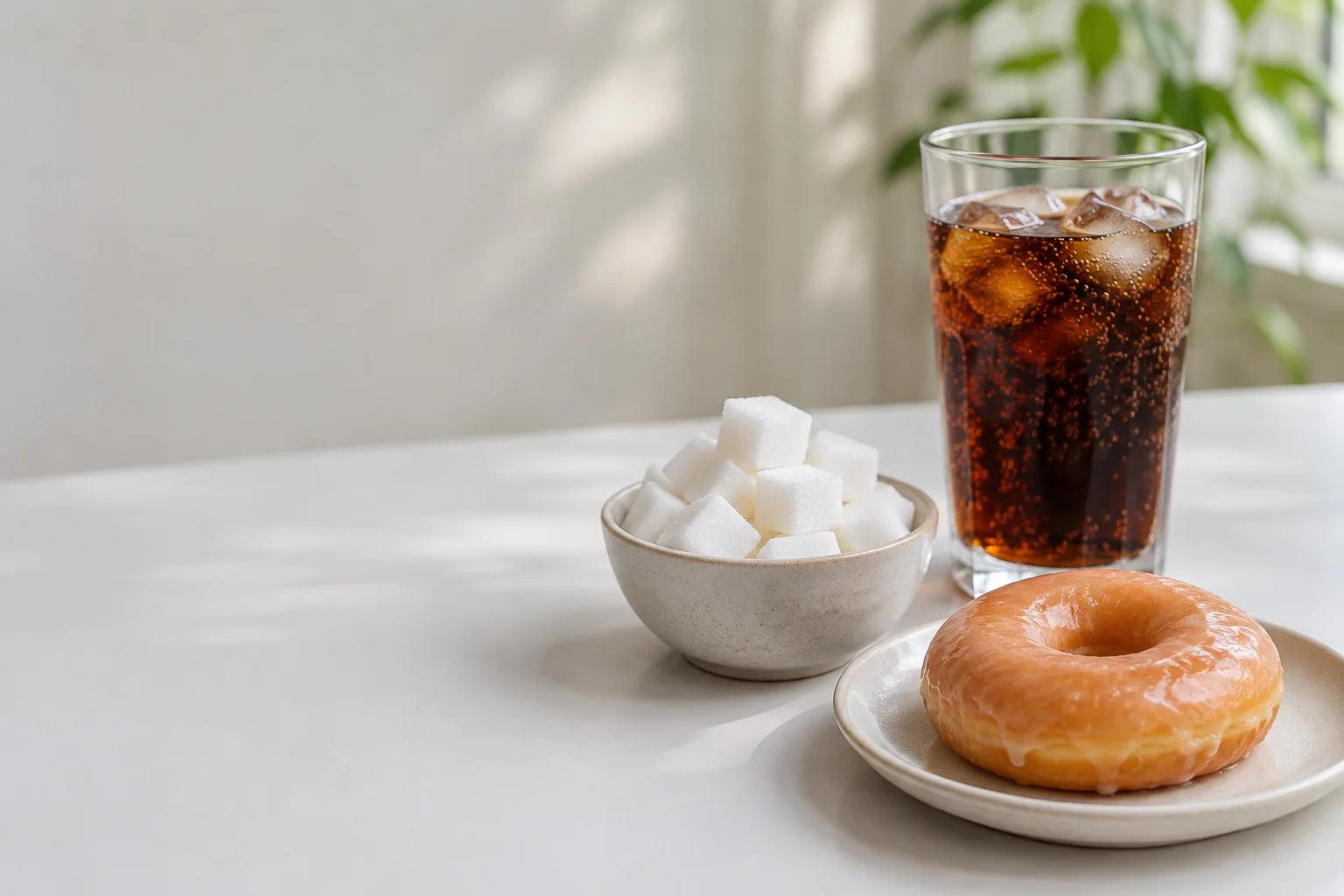
- Added sugars are sugars put in during processing, foods packaged as sweeteners, and sugars from syrups, honey and concentrated juices. The sugars naturally found in fruit, vegetables and milk do not count.
- The Dietary Guidelines for Americans, 2025-2030 say no amount of added sugars is recommended, and that one meal should contain no more than 10 grams.
- The CDC names sugar-sweetened beverages, desserts and sweet snacks as the leading sources of added sugars in the U.S. diet.
- The Nutrition Facts label lists added sugars in grams and as a percent of a 50-gram Daily Value. The FDA counts 5% or less as low and 20% or more as high.
- People with a chronic disease should ask a health care professional whether the guidelines need to be adapted for them.
Some sugar comes with food naturally, as in fruit and plain milk. Added sugars are the ones put in during processing or sold as sweeteners.1 The current Dietary Guidelines for Americans, dated January 2026, say that no amount of added sugars is recommended.2 This article covers what counts as an added sugar, what the guidelines say, where added sugars come from in the U.S. diet and how the Nutrition Facts label shows them.
Added sugars and natural sugars
The Food and Drug Administration (FDA) counts these as added sugars:1
- sugars added during the processing of foods, such as sucrose or dextrose
- foods packaged as sweeteners, such as table sugar
- sugars from syrups and honey
- sugars from concentrated fruit or vegetable juices
Added sugars do not include the sugars that occur naturally in milk, fruits and vegetables.1 The Dietary Guidelines draw the same line. Fruits and plain milk have naturally occurring sugars, and those are not considered added sugars.2
On a food label, "total sugars" covers both kinds: the sugars naturally present in the food and any that were added.1
What the guidelines say
The Dietary Guidelines for Americans have been issued every five years since 1980.3 The current edition covers 2025 to 2030. Its advice on added sugars is direct:2
| For | What the 2025-2030 guidelines say |
|---|---|
| Everyone | No amount of added sugars is recommended or considered part of a healthy or nutritious diet |
| One meal | No more than 10 grams of added sugars |
| Sugar-sweetened beverages, such as sodas, fruit drinks and energy drinks | Avoid |
| Infants and young children, from birth to 4 years | Avoid added sugars |
| Children aged 5 to 10 | No amount of added sugars is recommended |
| Adolescents aged 11 to 18 | Significantly limit sugary drinks and energy drinks |
| Snack foods | Follow the FDA's limits for foods labeled "healthy" |
For snacks, the guidelines give two examples of those limits. A grain snack such as crackers should not exceed 5 grams of added sugar per three-quarter-ounce whole-grain equivalent. A dairy snack such as yogurt should not exceed 2.5 grams per two-thirds-cup equivalent.2
The same sentence of the guidelines covers sugar substitutes. No amount of non-nutritive sweeteners, such as aspartame, sucralose or saccharin, is recommended either.2
The Centers for Disease Control and Prevention (CDC) sums up the guidance this way: children younger than 11 should not have any added sugar, and adolescents and adults should have no more than 10 grams of added sugars per meal.4
Where added sugars come from
The CDC says the leading sources of added sugars in the U.S. diet are sugar-sweetened beverages, desserts and sweet snacks. Its examples of desserts and sweet snacks are cookies, brownies, cakes, pies, ice cream, frozen dairy desserts, doughnuts, sweet rolls and pastries.4
The CDC also says data indicate that Americans eat and drink too much added sugar. In 2017-2018, the average daily intake was 17 teaspoons, both for people aged 2 to 19 and for adults aged 20 or older.4 CDC research found that about 30% of Americans aged 2 and older take in high amounts of added sugar each day, defined as more than 15% of daily calories.5
Drinks
Sugary drinks are the leading source of added sugars in the American diet, according to the CDC. They include regular sodas, fruit drinks, sports drinks, energy drinks and sweetened waters, as well as flavored coffees. Sugar and flavored creamer added to coffee or tea at home count too.5
The CDC lists the sugar in a 12-ounce serving of common drinks:5
| Drink | Teaspoons of sugar |
|---|---|
| Plain water or unsweetened tea | 0 |
| Lemonade made from powder | 3 |
| Sports drink | 5 |
| Brewed sweet tea | 7 |
| Energy drink | 9 |
| Regular soda | 10 |
| Fruit juice drink | 10 |
| Regular orange soda | 13 |
The CDC puts the added sugar in a 12-ounce regular soda at more than 10 teaspoons, or about 42 grams.5 That is more than four times the 10 grams the guidelines give as the most for a meal.2
The guidelines treat 100% fruit or vegetable juice separately. They say it should be consumed in limited portions or diluted with water.2
Foods where they are less obvious
The guidelines' own wording shows where added sugars turn up outside the dessert aisle. They advise choosing dairy with no added sugars, frozen, dried or canned vegetables and fruits with no or very limited added sugars, and meat with no or limited added sugars.2
The ingredient list is the place to check. The guidelines suggest looking for ingredients that include the word "sugar" or "syrup," or that end in "-ose." The names they list include:2
- high-fructose corn syrup, corn syrup, rice syrup and agave syrup
- fructose, glucose, dextrose, sucrose, maltose and lactose
- cane sugar, beet sugar and turbinado sugar
- fruit juice concentrate, honey and molasses
How the label shows them
The Nutrition Facts label lists added sugars in grams and as a percent Daily Value. The word "includes" in front of added sugars shows that they are part of the grams of total sugars.1
- Daily Value. The Daily Value for added sugars is 50 grams a day, based on a 2,000-calorie diet. Total sugars have no Daily Value, because no recommendation has been made for the total amount to eat in a day.1
- Low and high. The FDA counts 5% of the Daily Value or less as a low source of added sugars, and 20% or more as a high source.1
- Reading the two together. Ten grams of added sugars, the most the guidelines give for a whole meal, is 20% of the Daily Value. A single serving with that much is a high source by the FDA's measure.12
- Sugar, syrup and honey. Packages of single-ingredient sugars and syrups, such as table sugar, maple syrup or honey, list the percent Daily Value for added sugars. The FDA says they are labeled this way so that it does not look as if more sugars have been added to the product.1
Why it matters
The CDC says consuming too much added sugar can contribute to health problems such as weight gain and obesity, type 2 diabetes and heart disease.4 It says adults who often drink sugary drinks are more likely to have those problems, as well as cavities and gout.5 The FDA adds that too much added sugar can make it difficult to meet nutrient needs while staying within calorie limits.1
What the CDC suggests for drinks
The CDC's suggestions include:5
- choosing water, whether tap, bottled or sparkling, instead of sugary drinks
- adding berries or slices of lemon, lime or cucumber to water for flavor
- skipping the flavored syrups and whipped cream at the coffee shop
- reading the Nutrition Facts label to choose drinks that are low in calories and added sugars
When to talk with a clinician
The guidelines give general advice. They say that people with a chronic disease should talk with a health care professional to see whether the guidelines need to be adapted to their specific needs.2
A licensed clinician or a registered dietitian can look at your health and your usual diet and say what amount of added sugars makes sense for you.
Footnotes
-
U.S. Food and Drug Administration, Added Sugars on the Nutrition Facts Label, content current as of March 4, 2026. ↩ ↩2 ↩3 ↩4 ↩5 ↩6 ↩7 ↩8 ↩9 ↩10 ↩11
-
U.S. Department of Health and Human Services and U.S. Department of Agriculture, Dietary Guidelines for Americans, 2025-2030, January 2026. ↩ ↩2 ↩3 ↩4 ↩5 ↩6 ↩7 ↩8 ↩9 ↩10 ↩11 ↩12
-
U.S. Department of Agriculture and U.S. Department of Health and Human Services, Dietary Guidelines for Americans, checked November 23, 2026. ↩
-
Centers for Disease Control and Prevention, Get the Facts: Added Sugars, April 29, 2026. ↩ ↩2 ↩3 ↩4
-
Centers for Disease Control and Prevention, Rethink Your Drink, March 5, 2026. ↩ ↩2 ↩3 ↩4 ↩5 ↩6
More in Nutrition

Nutrition
Dietary Supplements: What the FDA Does and Does Not Check
The FDA does not approve dietary supplements before they are sold. Here is what the law requires, what a label must show, which claims are allowed and what a quality seal means.
Nov 23, 2026 · 6 min read
Nutrition
Fiber: How Much You Need and Where to Find It
Adults are advised to get 21 to 38 grams of fiber a day, depending on age and sex. The average American eats about 16. Here is where the numbers come from and which foods supply fiber.
Nov 23, 2026 · 5 min read

Nutrition
How Much Water Do You Need? What the Evidence Says
The National Academies set reference amounts for total water, not a number of glasses a day. Here is what those amounts include, why needs vary and the signs of dehydration.
Nov 23, 2026 · 5 min read