
Fiber: How Much You Need and Where to Find It
Adults are advised to get 21 to 38 grams of fiber a day, depending on age and sex. The average American eats about 16. Here is where the numbers come from and which foods supply fiber.
By Search & Report Editorial Team · Updated November 23, 2026 · 5 min read
Key takeaways
- The National Academies set fiber intakes of 38 grams a day for men and 25 for women up to age 50, and 30 and 21 grams after 50.
- The Daily Value on food labels is 28 grams a day, based on a 2,000-calorie diet.
- Americans eat about 16 grams of fiber a day on average, according to MedlinePlus.
- Beans, peas, lentils, whole grains, vegetables, fruits, nuts and seeds all supply fiber.
- Adding fiber gradually, with enough fluids, helps avoid gas, bloating and cramps. People with a digestive condition have reason to ask a clinician first.
Fiber is a type of carbohydrate found in plants. The body does not easily digest it in the small intestine.1 Health agencies agree that most Americans do not eat enough of it.21 This article explains how much is recommended, where the numbers come from, which foods supply fiber and why it helps to add it slowly.
How much fiber is recommended
There is more than one official number, because different bodies set them for different purposes.
The National Academies
In 2002, the Institute of Medicine's Food and Nutrition Board issued its first recommended intake levels for fiber.3 MedlinePlus, a service of the National Library of Medicine, gives the same figures today for adults aged 19 to 50.4
| Group | Fiber a day |
|---|---|
| Men aged 50 and younger | 38 grams |
| Women aged 50 and younger | 25 grams |
| Men over 50 | 30 grams |
| Women over 50 | 21 grams |
The figures are lower after 50 because people tend to eat less food as they age. The recommendations were based on studies that showed a higher risk of heart disease when diets were low in fiber.3
The Daily Value on food labels
The U.S. Food and Drug Administration (FDA) uses a single figure of 28 grams a day for the Nutrition Facts label. It is based on a 2,000-calorie diet, so a person's own figure may be higher or lower.1
The Dietary Guidelines for Americans
The current edition, for 2025-2030, was released in January 2026. It does not give a daily fiber figure in grams. It tells readers to prioritize fiber-rich whole grains, with a goal of 2 to 4 servings of whole grains a day. It also says high-fiber foods support a diverse gut microbiome, which may be beneficial for health.5
How much people actually eat
Americans eat about 16 grams of fiber a day on average, according to MedlinePlus.6
National survey data published by the U.S. Department of Agriculture point the same way. From August 2021 to August 2023, men aged 20 and older averaged 17.7 grams a day. Women averaged 15.0 grams.7
The FDA says most Americans do not get the recommended amount. It calls fiber a dietary component of public health concern, because low intakes are associated with potential health risks.1
What fiber does
Fiber comes in two main types:8
- Soluble fiber attracts water and turns to gel during digestion, which slows digestion. It is found in oat bran, barley, nuts, seeds, beans, lentils, peas and some fruits and vegetables. Research has shown that it helps lower cholesterol.
- Insoluble fiber is found in wheat bran, vegetables and whole grains. It adds bulk to the stool and appears to help food pass more quickly through the stomach and intestines.
The FDA says a diet high in fiber can increase the frequency of bowel movements, lower blood glucose and cholesterol levels, and reduce calorie intake.9 Both types of fiber can help people feel full.1
What large studies have found
A 2019 analysis in The Lancet pooled 185 observational studies and 58 clinical trials. In the observational studies, people who ate the most fiber had 15% to 30% lower rates of death from any cause and from cardiovascular disease than people who ate the least. They also had lower rates of coronary heart disease, stroke, type 2 diabetes and colorectal cancer. The reduction in risk was greatest at 25 to 29 grams of fiber a day.10
Observational studies show a pattern. On their own, they cannot prove cause. The authors wrote that the way risk fell as fiber intake rose indicates the link could be causal. They rated the certainty of the evidence for fiber as moderate.10
In the clinical trials, higher fiber intakes went with lower body weight, blood pressure and total cholesterol. The review left out trials of supplements, so its findings are about fiber in the diet. The authors noted that the results apply to the general population, not to people who already have a chronic disease.10
Where to find it
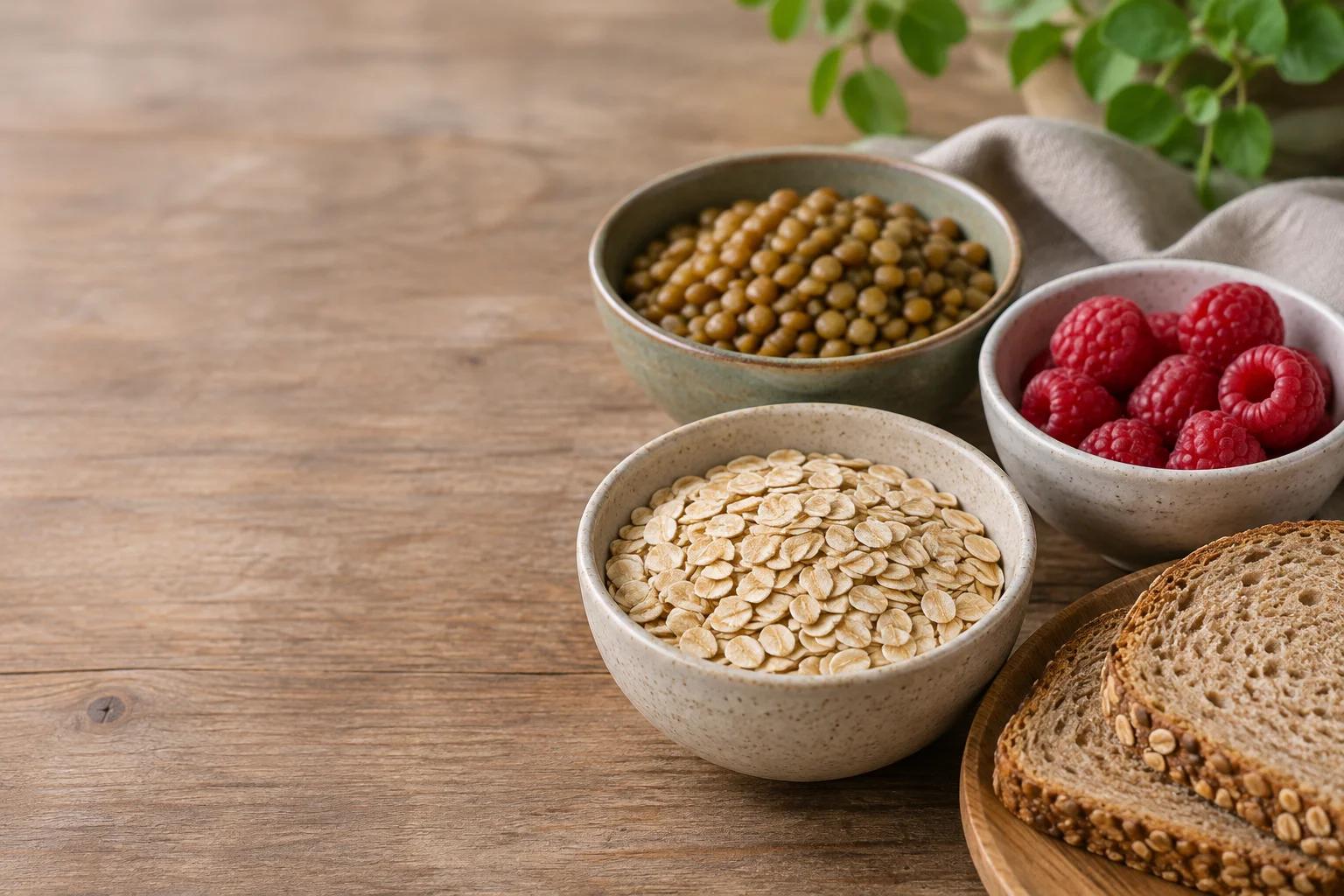
Fiber occurs naturally in plant foods. The National Institute of Diabetes and Digestive and Kidney Diseases (NIDDK) gives these examples:11
| Food group | Examples |
|---|---|
| Whole grains | Whole wheat bread and pasta, oatmeal, bran flake cereals |
| Legumes | Lentils, black beans, kidney beans, soybeans, chickpeas |
| Fruits | Berries, apples with the skin on, oranges, pears |
| Vegetables | Carrots, broccoli, green peas, collard greens |
| Nuts | Almonds, peanuts, pecans |
The FDA's list adds seeds, wheat bran and whole grains such as brown rice, popcorn and quinoa.1
Two details affect how much fiber a food delivers. Taking the peel off fruits and vegetables reduces it.6 And the Dietary Guidelines advise eating whole vegetables and fruits in their original form, and cutting back on highly processed, refined carbohydrates such as white bread and crackers.5
Beans, peas and lentils also count as protein foods in the Dietary Guidelines.5 Our article on protein while losing weight covers that side.
Reading the label
On a Nutrition Facts label, fiber is listed in grams and as a % Daily Value. The FDA's rule of thumb is that 5% DV or less per serving is low, and 20% DV or more is high.1
Not all the fiber on a label comes from the plant itself. The FDA also counts certain fibers that are added to foods, such as psyllium husk, cellulose, guar gum and pectin. It has determined that these have beneficial effects on health.1
Why to add fiber gradually
A sudden jump in fiber can be uncomfortable. MedlinePlus says increasing fiber too quickly can lead to gas, bloating and cramps.2 The advice from MedlinePlus and NIDDK comes down to three points:
- Go slowly. Add fiber gradually over a few weeks,6 a little at a time, so the body gets used to the change.11
- Drink enough. Liquids help fiber work better.11 Not getting enough fluids may make constipation worse instead of better.4
- Ease off if needed. People who develop bloating or gas may need to cut back for a few days.4
More is not always better. Too much fiber may interfere with the absorption of minerals such as iron, zinc, magnesium and calcium.6
When to talk with a clinician
Fiber figures are written for the general population. A licensed clinician or a registered dietitian can help in these situations:
- A digestive condition, such as those in the note above, or a history of bowel surgery.12
- A chronic disease. The Dietary Guidelines advise asking a health care professional whether the guidelines need to be adapted.5
They can suggest an amount and a pace that fit your health.
Footnotes
-
U.S. Food and Drug Administration, Interactive Nutrition Facts Label: Dietary Fiber, checked November 23, 2026. ↩ ↩2 ↩3 ↩4 ↩5 ↩6 ↩7 ↩8
-
MedlinePlus, National Library of Medicine, Dietary Fiber, last updated April 25, 2023. ↩ ↩2
-
National Academies, Institute of Medicine, Report Offers New Eating and Physical Activity Targets To Reduce Chronic Disease Risk, September 5, 2002. The release summarizes the report Dietary Reference Intakes for Energy, Carbohydrate, Fiber, Fat, Fatty Acids, Cholesterol, Protein, and Amino Acids. ↩ ↩2
-
MedlinePlus, National Library of Medicine, High-fiber foods, reviewed July 20, 2026. ↩ ↩2 ↩3
-
U.S. Department of Health and Human Services and U.S. Department of Agriculture, Dietary Guidelines for Americans, 2025-2030, January 2026. ↩ ↩2 ↩3 ↩4
-
MedlinePlus, National Library of Medicine, Fiber, reviewed July 22, 2026. ↩ ↩2 ↩3 ↩4
-
U.S. Department of Agriculture, Agricultural Research Service, What We Eat in America, NHANES August 2021-August 2023, Table 1: Nutrient Intakes from Food and Beverages, checked November 23, 2026. ↩
-
MedlinePlus, National Library of Medicine, Soluble vs. insoluble fiber, reviewed August 25, 2026. ↩
-
U.S. Food and Drug Administration, How to Understand and Use the Nutrition Facts Label, content current as of March 5, 2024. ↩
-
Reynolds A, et al. Carbohydrate quality and human health: a series of systematic reviews and meta-analyses. The Lancet 2019;393(10170):434-445. PubMed ↩ ↩2 ↩3
-
National Institute of Diabetes and Digestive and Kidney Diseases, Eating, Diet, & Nutrition for Constipation, last reviewed May 2018. ↩ ↩2 ↩3
-
MedlinePlus, National Library of Medicine, Low-fiber diet, reviewed July 24, 2024. ↩ ↩2
More in Nutrition

Nutrition
Added Sugars: Where They Hide and What the Guidelines Say
The 2025-2030 Dietary Guidelines say no amount of added sugars is recommended and cap a meal at 10 grams. Here is what counts, where added sugars hide and how labels show them.
Nov 23, 2026 · 6 min read

Nutrition
Dietary Supplements: What the FDA Does and Does Not Check
The FDA does not approve dietary supplements before they are sold. Here is what the law requires, what a label must show, which claims are allowed and what a quality seal means.
Nov 23, 2026 · 6 min read

Nutrition
How Much Water Do You Need? What the Evidence Says
The National Academies set reference amounts for total water, not a number of glasses a day. Here is what those amounts include, why needs vary and the signs of dehydration.
Nov 23, 2026 · 5 min read